The Difference in One Sentence
A single-acting cylinder uses hydraulic pressure to move in one direction only and relies on gravity, a spring, or an external load to return. A double-acting cylinder uses hydraulic pressure in both directions, so it can push and pull under full control.
That single difference determines how the cylinder is plumbed, how it is controlled, how much force it can deliver on each stroke, and where it can be used. Getting the choice wrong is expensive: a single-acting cylinder in an application that needs a powered return will simply fail to return, and a double-acting cylinder where gravity would have done the job adds cost, complexity, and hydraulic lines for nothing.
How Single-Acting Cylinders Work
A single-acting cylinder has one pressurized chamber. Hydraulic fluid enters on one side of the piston and pushes it in a single direction — almost always the extend direction. The return stroke happens because something else moves the piston back:
- Gravity return — the most common arrangement. The weight of the raised load pushes the cylinder back down. Dump trailer hoists, tipping bodies, and many lifting functions work this way.
- Spring return — a mechanical spring inside the cylinder drives the piston back. Used where the load cannot return itself, such as clamping and positioning functions.
- External force return — another actuator, a linkage, or manual force moves the cylinder back.
Because there is only one hydraulic chamber, a single-acting cylinder needs one hydraulic line and a simple directional valve. The non-pressurized side of the piston is vented, either to atmosphere or to a reservoir.
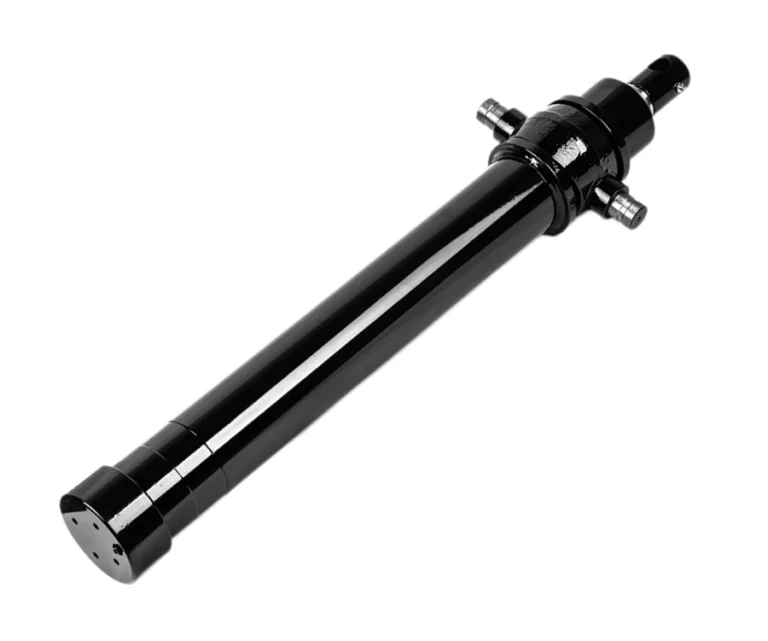
A common variant is the telescopic (multi-stage) single-acting cylinder, in which two or more nested stages extend in sequence to give a very long stroke from a short collapsed length. Telescopic hoists are the standard solution for dump trailers and tipper bodies, where the cylinder must fit under the body when retracted but lift it through a long arc. Our telescopic cylinders for dump trailers are built for exactly this duty.
How Double-Acting Cylinders Work
A double-acting cylinder has two pressurized chambers separated by the piston. Fluid can be directed to either side, so the cylinder produces controlled force in both the extend and retract directions.
This requires two hydraulic lines and a directional control valve that can route pressure to either port while returning the opposite port to tank. In practice the cylinder becomes a fully controllable actuator: it can push, pull, hold position against a load, and move at a controlled rate in both directions.
The trade-off is important and often overlooked: retract force is lower than extend force on every double-acting cylinder. The rod occupies part of the piston area, so the retract stroke works on the annular area — piston area minus rod area. Depending on the bore-to-rod ratio, retract force can be anywhere from about 50% to 70% of extend force. A cylinder selected on extend force alone may be unable to retract its own load.
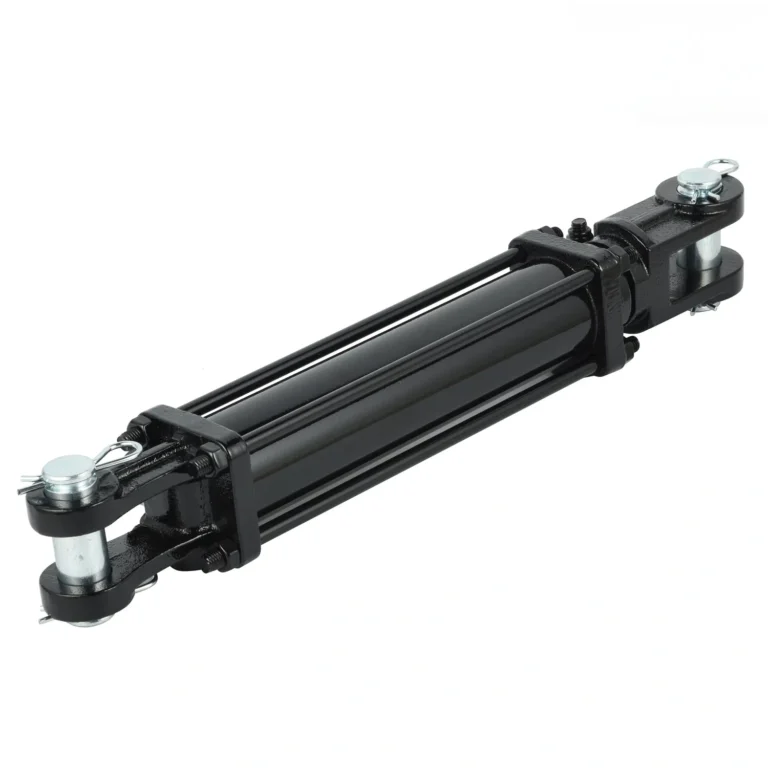
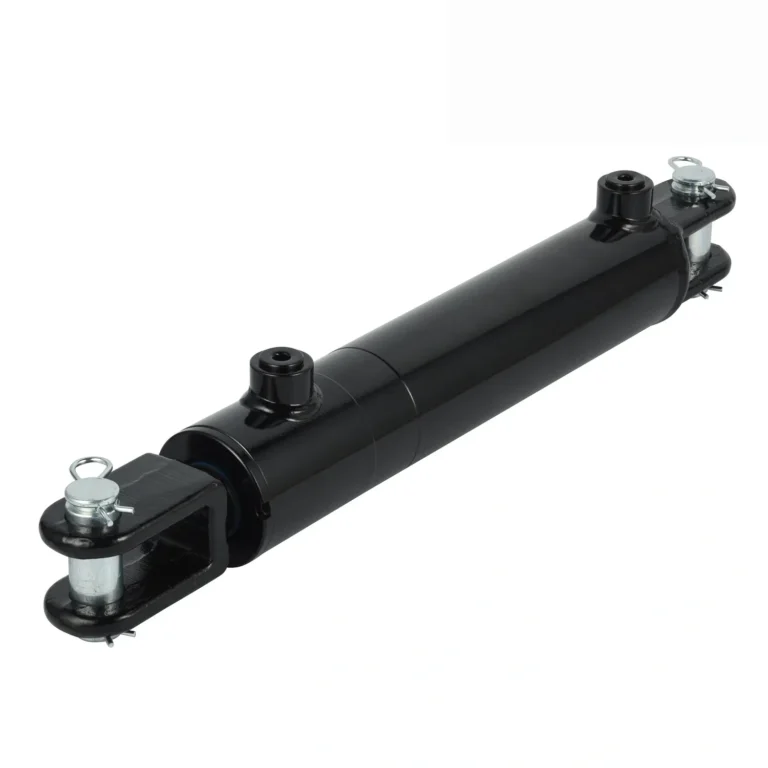
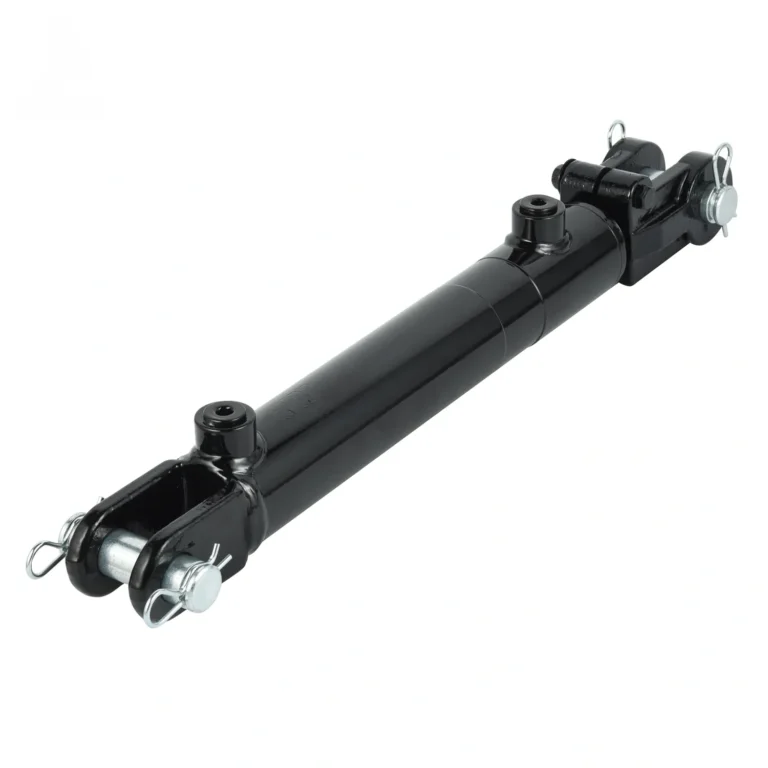
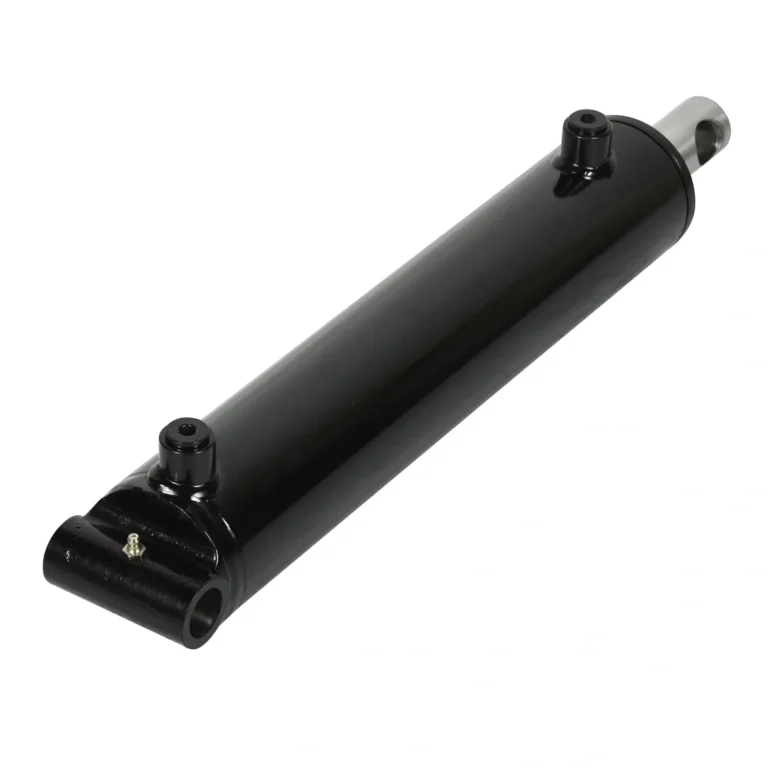
Common double-acting designs include tie rod cylinders for industrial machinery and presses, and welded clevis-mount cylinders for mobile equipment and linkages.
Side-by-Side Comparison
| Characteristic | Single-Acting | Double-Acting |
|---|---|---|
| Powered directions | One (usually extend) | Both extend and retract |
| Return method | Gravity, spring, or external force | Hydraulic pressure |
| Hydraulic lines required | One | Two |
| Valve complexity | Simple | Directional control valve required |
| Force control on return | None — return is uncontrolled | Full control |
| Ability to hold position under load | Limited; depends on valving and load | Yes, in both directions |
| Cost per cylinder | Lower | Higher |
| Circuit cost | Lower | Higher — extra lines and valving |
| Typical uses | Dump hoists, jacks, tipping, clamping | Excavators, presses, steering, positioning |
Where Single-Acting Wins
Single-acting is the right choice when the return stroke does not need hydraulic power — which is more often than it first appears.
- Dump trailer and tipper hoists. The body’s own weight returns the cylinder. A telescopic single-acting cylinder gives long stroke, high lift force, and a short collapsed length in one package. This is the dominant design across construction and waste-handling vehicles.
- Lifting and jacking. Where a load only ever needs to be raised, gravity provides the return.
- Clamping and holding. Spring-return single-acting cylinders apply force in one direction and release when pressure is removed — a natural fit for workholding and braking.
- Cost-sensitive high-volume applications. One hydraulic line instead of two, and a simpler valve, reduces system cost across the machine.
- Space-constrained installations. Fewer lines and simpler plumbing matter where routing space is tight.
Where Double-Acting Wins
Double-acting becomes necessary as soon as the return stroke has to do work, move quickly, or be controlled.
- Any application where the return stroke carries load. If the cylinder must pull, or retract against resistance, gravity will not do it.
- Excavators, loaders, and articulated equipment. Boom and bucket functions need powered movement in both directions and precise control. See our work in construction equipment.
- Presses and industrial machinery. Both the pressing and retracting strokes are under hydraulic control for repeatability and speed.
- Positioning and holding functions. Where a load must be held in position against gravity or opposing force, hydraulic pressure on both sides provides the control that a single-acting circuit cannot.
- Time-critical return strokes. When the return must be fast and predictable — for example in high-cycle automation — relying on gravity makes cycle time dependent on load weight.
- Applications with a horizontal or inverted axis. Gravity return only works when gravity acts in the right direction. Horizontal and inverted cylinders need powered return.
The Orientation Test
Much of the choice comes down to one practical question: which way does gravity point relative to the return stroke?
- Vertical, lifting a load upward — gravity is a free return. Single-acting is viable and often optimal.
- Horizontal, or pushing a load sideways — gravity offers no return force. Double-acting is normally required.
- Inverted, pulling a load downward — gravity assists the working stroke but opposes the return. Double-acting is normally required.
The second question is whether the return must be controlled. A load that falls back under its own weight is a load that cannot be stopped by the cylinder — it can only be throttled by restricting flow out of the cylinder, which generates heat and loses control precision. If the return must be smooth, fast, modulated, or held at an intermediate position, that is a double-acting requirement regardless of orientation.
What About Telescopic Cylinders?
Telescopic cylinders are commonly single-acting and are a special case worth understanding separately, because they solve a different problem: obtaining a long stroke from a short retracted length.
A telescopic cylinder has nested stages that extend one after another. This gives two advantages for tipping and lifting applications:
- Compact when retracted. A multi-stage unit fits into the space available under a vehicle body.
- High initial force. The largest (first) stage has the largest area, so the cylinder produces its greatest force at the start of the lift — exactly when the load’s mechanical disadvantage is greatest on a tipping body.
The trade-off is that force decreases as each successive, smaller stage extends, and the design is more complex with more seals and more sliding surfaces to protect. Telescopic cylinders are also available in double-acting versions for applications that need powered retraction, though single-acting gravity-return designs dominate tipping applications.
Common Misconceptions
- “Double-acting means double the force.” It does not. It means force is available in both directions. On the extend stroke, force depends on bore and pressure exactly as it does for a single-acting cylinder — and retract force is actually lower.
- “Single-acting is a cheaper, lower-quality option.” It is an engineering choice matched to the application. A telescopic single-acting dump hoist is a demanding, high-load component, not a compromise.
- “A single-acting cylinder will hold its load.” Holding depends on the valving and the load path, not on the cylinder alone. A gravity-return cylinder under a held load depends on the valve to trap pressure, and many do not hold reliably for long periods.
- “You can always convert by adding a second line.” Converting a single-acting cylinder to double-acting is not a plumbing change — it requires a different cylinder with the correct sealing arrangement, ports, and pressure-bearing surfaces on both sides of the piston.
Frequently Asked Questions
What is the difference between single-acting and double-acting hydraulic cylinders?
A single-acting cylinder is powered hydraulically in one direction and returns by gravity, spring, or external force. A double-acting cylinder is powered hydraulically in both directions and can push and pull under full control.
Which is better, single-acting or double-acting?
Neither is universally better. Single-acting is simpler and more economical where the return stroke needs no hydraulic power — such as tipping and lifting. Double-acting is necessary where the return carries load, must be fast or controlled, or where gravity cannot provide a return force.
Can a single-acting cylinder be used horizontally?
Only with a spring return or an external return force. Gravity return requires the cylinder to be oriented so that the load’s own weight retracts it, which a horizontal installation does not provide.
Why do dump trailers usually use single-acting cylinders?
Because the raised body’s own weight returns the cylinder, hydraulic power is only needed in the lifting direction. A telescopic single-acting cylinder provides a long stroke, high initial lifting force, and a compact retracted length — an efficient combination for tipping duty.
Is retract force the same as extend force on a double-acting cylinder?
No. On the retract stroke, pressure acts on the annular area — piston area minus rod area — so retract force is always lower than extend force. Depending on the bore-to-rod ratio it may be only half as much.
Match the Cylinder to the Job
The choice between single-acting and double-acting follows from the application, not from a preference. If the return stroke needs no hydraulic power and gravity is on your side, single-acting is simpler and cheaper. If the return must work, move fast, or hold position, it has to be double-acting.
If you are unsure which design fits a specific machine, send the details: what the cylinder does, how it is mounted, which direction it is loaded, and how the return must behave. We will recommend the configuration rather than leaving you to guess. Browse our cylinder ranges, or talk to us about custom manufacturing for non-standard mounting and stroke requirements.
Related Technical Guides
- How to Choose the Right Hydraulic Cylinder — A buyer’s checklist for specifying load, force, bore, rod, mounting and seals.
- Hydraulic Cylinder Sizing Guide — How to calculate bore from force and size the rod for buckling, with worked examples.
- How Does a Hydraulic Cylinder Work? — Pascal’s law, internal components and the extend and retract strokes.